


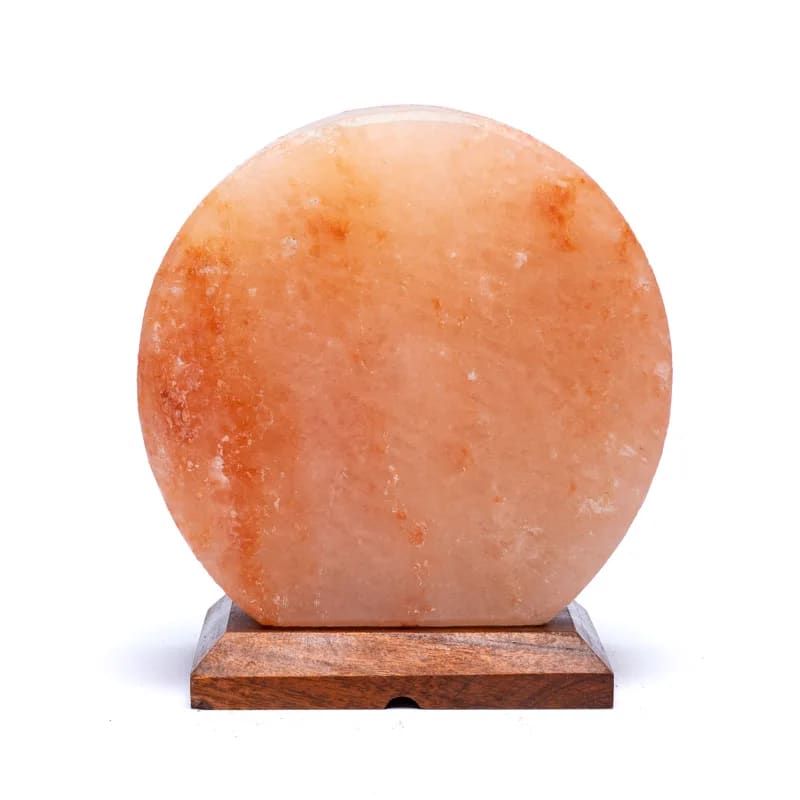
Salt lamp tree of life with cable and LED bulb
Salt lamp tree of life with cable and LED bulb
SKU:21156
Other colors/variants of this article:


Description
This salt crystal lamp creates a clean and pleasant atmosphere in any room. Its diffused light gives off a warm glow and a sense of harmonious calm. Skilled craftspeople carefully select, work and shape the salt crystals used for these lamps.
A salt lamp purifies the air of dust particles and electrosmog through ionisation. The larger the lamp, the larger the area that is ionised. Every salt lamp is unique in shape and colour.
This unique gift:
- is a natural air purifier (ioniser)
- balances the humidity in a room
- gives a room a warm glow and a positive atmosphere
- promotes a good night's sleep
- improves the Feng Shui near a computer or in a study, living room or bedroom
Product features
Salt crystal lamp with acacia wood base and tree of life
Plug: 2-pin plug with CE marking
Fitting: E14, 220-240 volts
Includes 5 W LED bulb
Note: we recommend sticking felt pads under the salt lamp to prevent scratches when it is moved.
Feng Shui
Feng Shui is a philosophy more than 3,000 years old that teaches how our surroundings influence our wellbeing and how negative influences can be turned into positive ones. The aim of Feng Shui is to arrange our living or working environment in a way that encourages a harmonious flow of Chi (life energy). In Chinese philosophy, everything revolves around harmony and balance between the complementary forces of yin and yang, such as masculine and feminine.
The Tree of Life in different religions and spiritual traditions
The Tree of Life is a powerful symbol that has appeared in religious and spiritual traditions around the world for centuries.
Tree of Life, ancient Iran
Iranian mythology has various depictions of sacred plants and trees associated with life, healing and eternity, such as the guardians of plants and the goddesses of trees and of immortality.
Tree of Life, Bahá'í Faith
The concept of the Tree of Life appears in the writings of the Bahá'í Faith. There it refers to the Manifestation of God, the great teacher who appears to humanity from time to time.
Tree of Life, Buddhism
In Buddhism, the bodhi tree (Ficus religiosa) is the tree under which Prince Siddhartha sat when, around 2,500 years ago in Bodh Gaya, India, he attained Enlightenment and became the Buddha (the Awakened One). The bodhi tree has therefore become a symbol of new life in the sense of spiritual awakening.
Tree of Life, China
In Chinese mythology, the tree of life is often depicted with a phoenix and a dragon, the dragon representing immortality. A Taoist tale tells of a tree that produces a peach of immortality once every three thousand years. Whoever eats the fruit gains immortality.
Tree of Life, Europe
Antoine-Joseph Pernety, a well-known eighteenth-century writer and alchemist, linked the Tree of Life with the Elixir of Life and the Philosopher's Stone.
Tree of Life, Germanic paganism and Norse mythology
Trees play a prominent role in Germanic paganism. They appear in several surviving texts from that era and even in the names of their gods. In Norse religion, the tree of life appears as Yggdrasil, the world tree that stretches across nine worlds and is connected to the three magical wells of all life: the well of wisdom and knowledge, the well of past, present and future, and the well of space, the cosmos itself.
Tree of Life, Islam
Trees also play an important role in the Quran. The date palm is mentioned around twenty times and is described as originating from paradise and as a remedy for poisoning. It is the tree under which, according to the Quran, Mary gave birth to Jesus. Of the olive tree it is written: "He showed the pure river of the water of life, clear as crystal, proceeding from the throne of the Lamb of God. In the middle of the street and on either side of the river grows the tree of life, which yields twelve baskets of fruit every month. And the leaves of this tree are for the healing of the people."
Tree of Life, Mesoamerica
In Maya culture, the tree of life was represented by a ceiba tree. It stands for the axis mundi, the stable centre of the universe.
Tree of Life, Judaism
The tree of life is mentioned in the Book of Genesis. The best-known tree in the Garden of Eden is the tree of the knowledge of good and evil, whose fruit Adam and Eve ate, causing them to be driven out of paradise. Judaism also speaks of the tree of life, or the tree of souls. This tree brings forth souls and therefore life itself.
Tree of Life, Native America
The tree of life motif is firmly rooted in Native American traditions, including Ojibwe cosmology. The tree of life represents everything that lives on this planet and in the universe. It beats the rhythm of life, day after day, year after year, life after life. Native Americans place great value on all living things and are masters at keeping the balance between their own needs and what nature provides.
Specifications
- Article
- 21156
- EAN
- 8721139295199
- Country of origin
- PK
- Size in cm
- ± 22 x 19 x 10
- Weight in g
- ± 5000
- Total weight in g
- 5200
- Packaging
- Cardboard box
- Includes leaflet in
- NL|EN|DE|FR|IT|ES
- Raw material
- Himalayan salt
Documents
GPSR Document



Additional products
-

-

-

-
 Sale
Sale


