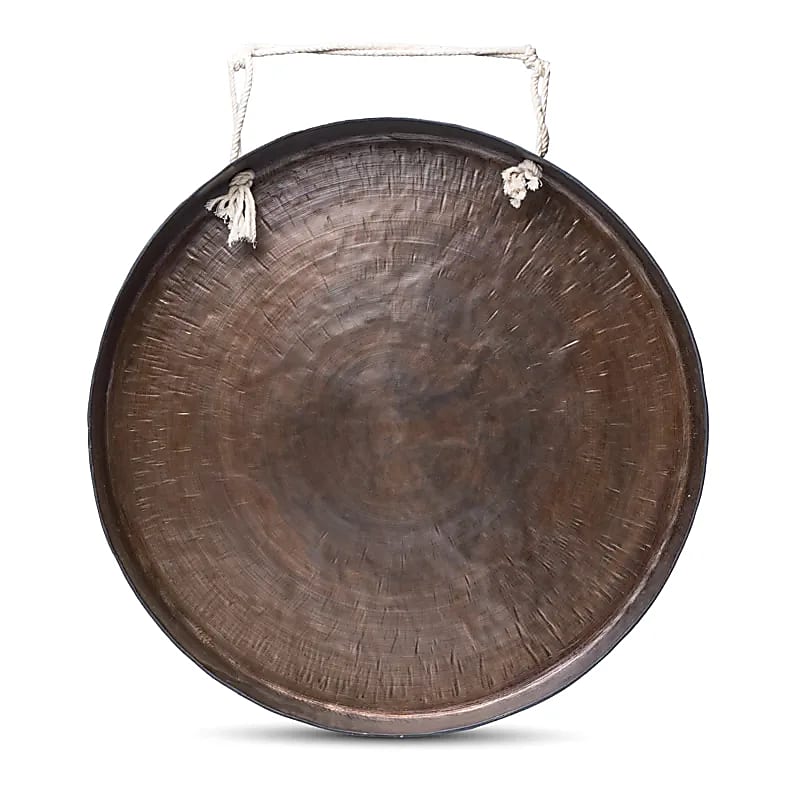
Nepalese gong 7 Chakras engraved
Nepalese gong 7 Chakras engraved
SKU:17340
Other colors/variants of this article:


Description
Ornately carved Nepalese gong with deep, upturned rim. The sound is rich, with little 'crash' and a long sustain. Near the rim, the tone is considerably lighter, making this visually highly attractive gong pleasantly accessible to play.
The gong comes with a complimentary mallet (item 16768).
The engraving on this gong is composed of the 7 chakra symbols from Sanskrit, the Flower of Life, and the snake staff colloquially known as an Aesculape (healer's staff), but which is in reality a Caduceus. The Caduceus and the Aesculape are both symbols from ancient times, though with different meanings and origins. The Aesculape, with only one snake coiling around a staff, refers directly to Asclepius, the Greek god of healing and medicine. In contrast, the two snakes on the Caduceus represent the unification of opposing principles such as male/female and sun/moon, and the staff itself represents the connection between heaven and earth.
Nepali gong
The Nepali gong (Chinese: "tam-tam") is a traditional percussion instrument originating in East Asia. This impressive gong has a flat striking surface and produces a low fundamental tone, followed by a burst of sound with many overtones. With this grand, resonant sound, the Nepalese gong is a favourite in both concert halls and meditative spaces.
Materials
The gong is traditionally manufactured from a high-quality bronze alloy consisting of copper and tin. This material is expertly forged to create a full sound
Playing accessories
To play the Nepali gong, one typically uses a mallet or beater, which is lined with felt or leather. The choice of tool affects the quality of the sound. For instance, softer mallets produce a deep and droning sound, while harder mallets provide a clear and penetrating sound. The Nepalese gong produces a wide range of sounds, depending on the percussion instruments used:
Soft mallet: Creates a deep, resonant and mysterious sound that slowly builds and expands in space.
Hard mallet: Delivers a sharp, clear and fast-rising sound that cuts through space and fades quickly.
Rubber beater: Produces a compact, defined sound with fewer overtones, ideal for specific musical accents.
Each of these playing implements allows the musician to adapt the emotive and acoustic impact of the gong to the specific needs of the performance or setting.
Flower of Life symbol
The Flower of Life is one of the standard and most powerful symbols in nature, in sacred geometry. It is an ancient metaphor for the connection of all life in the Universe. In many cultures this symbol is well known.
Chakras
Chakras are subtle energy points, literally called energy wheels. They function as places of energy exchange. In fact, we have hundreds of chakra points spread throughout our subtle energy system. However, the most well-known are the seven main chakras, which are connected in the central energy channel of our body, which runs along our spine. When the chakras function properly, these centres are gateways for vital life energy that enters our body through channels (nadis) and meridians through our subtle body. At the same time, they are also vanishing points for low-frequency energy to flow back to the subtle bodies that are being transformed. Each of the seven major chakras represents a level of consciousness or developmental stage of life, viewed from the perspective of our physical existence. Chakras may function less when they are in a negative state for a long time due to negative habits and accumulated emotions. This makes it difficult for the personality to fully integrate the level of consciousness that each chakra represents. When the chakras are open and in balance, they form an integrated system in which each chakra is dependent on the others for optimal function.
Specifications
- Article
- 17340
- Country of origin
- NP
- Material
- Bronze
- Size in cm
- 60
- Weight in g
- 9690
- Total weight in g
- 12300
- Packaging
- Cardboard box
Documents
GPSR Document