


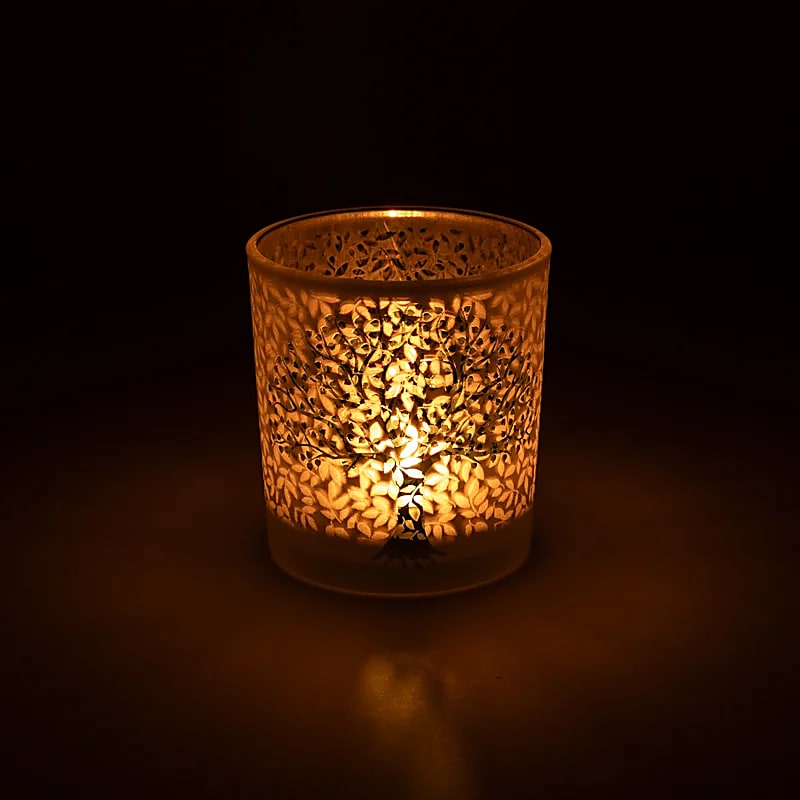
Tealight holder frosted glass/metallic Tree of Life
Tealight holder frosted glass/metallic Tree of Life
SKU:1139
Other colors/variants of this article:
-
 Moon and sun
-
 Flower of Life
-
 Buddha
-
 Lotus
-
 Spiritual hands
-
 Zodiac signs
-
 Moon phases
-
 Rainbow
-
 Dream catcher
-
 All-seeing eye
-
 Mandala
-
 Ganesha
-
 Angel wings
-
 Mystical Flower of Life
-
 Mystical Tree of Life
-
 Mystical Lotus
-
 Mystical Moon Phases
-
 Mystical Goddess
-
 Mystical Eye of Providence
-
 Mystical Crescent


Description
Suitable for burning votive candles and tealights.
The Tree of Life in different religions and spiritual traditions
The Tree of Life is a powerful symbol that has appeared in various religious and spiritual traditions around the world for centuries.
Tree of Life, Buddhism
In Buddhism, the Bodhi tree or banyan is the tree (Ficus religiosa) under which Prince Siddhartha sat when, around 2,500 years ago in Bodh Gaya, India, he attained Enlightenment and became the Buddha (the Awakened One). The Bodhi tree has thus become a symbol of new life in the sense of spiritual awakening.
Tree of Life, China
In Chinese mythology, the Tree of Life is often also depicted by a phoenix and a dragon, with the dragon representing immortality. A Taoist story tells of a tree that produces a peach of immortality once every three thousand years. Anyone who eats the fruit will gain immortality.
Tree of Life, Europe
Antoine-Joseph Pernety, a famous eighteenth-century writer and alchemist, identified the Tree of Life with the Elixir of Life and the Philosopher's Stone.
Tree of Life, Germanic paganism and Norse mythology
Trees play a prominent role in Germanic paganism. They appear in several surviving texts from that era and even in the names of their gods. In Norse religion, the Tree of Life appears as Yggdrasil, the world tree that stretches across 9 realms and is connected to the 3 magical wells of all life: the well of wisdom and knowledge, the well of past, present and future, and the well of space, the cosmos itself.
Tree of Life, Islam
Trees also play an important role in the Quran. The date palm is mentioned around 20 times and is described as originating from paradise and as a healer in cases of poisoning. It is the tree under which Mary, according to Allah, gave birth to Jesus. Of the olive tree it is written: "He showed the pure river of the water of life, clear as crystal, flowing from the throne of the Lamb of God. In the middle of the road and on the other side of the river grows the tree of life, which yields twelve baskets of fruit every month. And the leaves of this tree serve to heal the people. "
Tree of Life, Mesoamerica
In Maya culture, the Tree of Life was represented by a ceiba tree. It represents the axis mundi, the stable centre of the universe.
Tree of Life, Judaism
The Tree of Life is mentioned in the Book of Genesis. The best-known tree in the Garden of Eden is the tree of the knowledge of good and evil, whose fruit Adam and Eve ate, causing them to be driven out of paradise. Judaism also speaks of the tree of life, or the tree of souls. This tree produces souls and therefore life itself.
Tree of Life, Native America
The Tree of Life motif is firmly present in Native American traditions, including Ojibwe cosmology. The Tree of Life represents everything that lives on this planet and in the universe. It beats the rhythm of life, day after day, year after year, lifetime after lifetime. Native Americans attach great value to all living things and are masters at keeping the balance between their own needs and what nature provides.
Specifications
- Article
- 1139
- EAN
- 8720088291573
- Country of origin
- CN
- Material
- Glass
- Size in cm
- 7.3 x 8
- Weight in g
- 170
- Total weight in g
- 190
- Packaging
- Cardboard box
Documents
GPSR Document
Additional products
-

-
 Sale
-


